
The registration process
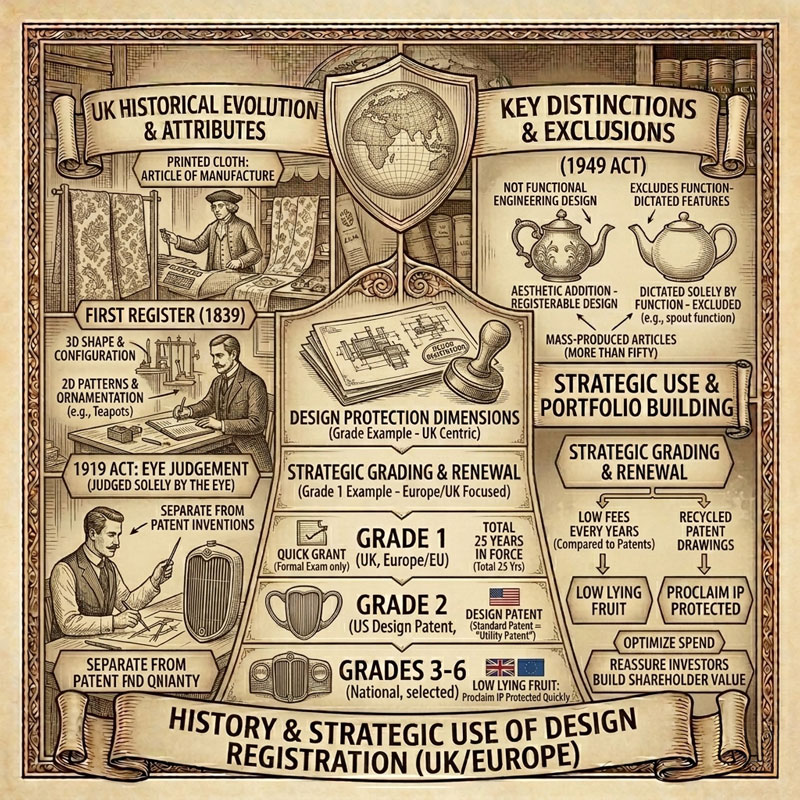
As understood by the Design Registration Process, a design concerns the aesthetic eye appeal of a product and should not be confused with Design Engineering which is much more “the stuff of patents”. The design may be a three-dimension object, with shape and configuration, or a two-dimensional pattern or ornamentation applied to a product.
Compared to patents, design registration is relatively fast and inexpensive. Some proposals are clearly protectable by design registration and are not suitable for patent protection. A patent addresses a technical problem and provides a functional solution whereas a design, in the IP context, is an aesthetic work of craftsmanship. However, some engineering items may have a distinctive shape. Consequently, an application for design registration could be filed in addition to a patent application. Some of the drawings may appear in both.
It is likely that a design application will be easier to prepare than a related patent application. However, the patent application should be filed first given that the application for design registration often progresses quickly resulting in publication.
The design itself is represented by a series of images or illustrations for which the correct name in a UK application is Representations (often abbreviated to “reps”). The Design Registry in the UK has very few formal requirements for the representations and they will accept photographs. Our preference is to file line drawings (similar to patent Figures) for the following reasons:
- we may be preparing drawings for a patent application;
- drawings do not include ambiguous shading
- in many jurisdictions (e.g. US) only drawings are acceptable.
The representations for a three-dimensional design usually show the object from all six directions and comprise six orthographic drawings with a single isometric of perspective drawing.
The filing of a first application initiates a six-month convention term during which similar applications may be filed elsewhere with a claim to convention priority. However, local requirements must be considered – such as shading requirements in the US.
The United States does not recognise Design Registration as such but provides for two types of patents: a Utility Patent (as conventionally recognised) and a Design Patent. A US utility patent should not be confused with a Utility Model which is available in some jurisdictions including Germany and China. A utility model is a “petty patent” protecting proposals that are novel but not inventive enough to allow full patent protection.
In most countries a formalities examination is performed, of varying scrutiny, but in the UK and Europe there is no substantive examination to determine novelty – although lack of novelty is a ground for revocation. This position may change but it does explain why the procedure is relatively quick and inexpensive.