
The History of Patents
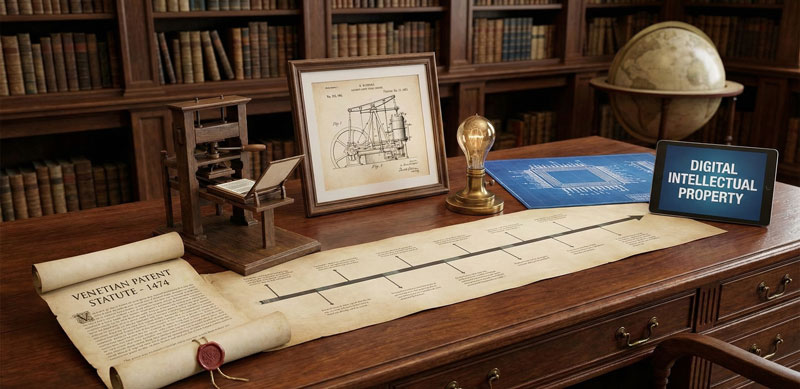 A letters patent is an open letter: historically a monopoly granted by the Crown for payment. In England, their initial purpose was to generate an income for the Crown. However, the Statute of Monopolies was enacted in 1624 granting patent rights of 14 years for the sole making or working of any manner of new manufacture … to the true inventor. Furthermore, importers of foreign discoveries were granted domestic patent protection – known for a time as “patents of importation”. However, these patents were expensive and extra fees were required for Scotland (Great Britain not being established until 1707) and Ireland, the United Kingdom not until 1800.
Since 1713 it became necessary to describe the invention for which protection was being claimed. This was an important step because an invention could be kept confidential or patented but not both. Later, patents of importation were superseded by patents for creative invention. Thus, it has become accepted that an invention reflects the creative technical contribution made by the inventor.
A patent specification must describe an embodiment of the invention but this is not a full and detailed description of a commercial product or process. It is then for someone of ordinary skill to fill in the gaps and, more significantly, for commercial investments to be made to realise an actual innovation. Thus, an invention is a creative technical step and remains intellectual. An innovation may make use of the invention (embody it) but is only achieved when presented in the form of a real product or process.
Patent reforms were made in 1852 but this did not introduce an examination system and fees were still very high. Realistic fees and professional examiners did not appear until 1883 but examination for novelty did not arrive until 1902. Chemical products were excluded until the patents Act of 1949. Changes were made primarily influenced by what was perceived as the successful patent system in the United States.
The US constitution states the intention of promoting the progress of science and the useful arts by securing … for inventors the exclusive right to their … discoveries. Patents in the United States have always been taken seriously by the top brass. Thomas Jefferson (1743 – 1826) drafted the first US patents Act and Abraham Lincoln (1809 – 1865) stated that “Patents for inventors add the fuel of interest to the fire of genius and encourage investments to be made in new ideas”. The statute of 1790 had become a registration (non-examined) system but full examination was re-introduced in 1836.
From 1871, employment contracts in the United States could insist that inventions made by employees as a result of their employment were assigned to the employer. However, it was the Act of 1952 that codified the meaning of an invention and recognized that it may have been the result of routine work performed by many employees of an R&D facility – and not a flash of inspiration on the part of an individual inventor. The 1952 Act represents three major transitions: to an inventor being employed to invent, an owner having access to sufficient capital to convert an invention to an innovation and for the patenting procedures being written by and, some may say, for the benefit of, patent lawyers.
The Paris Convention of 1883 provides a twelve-month term during which patents may be filed in many countries after a first application has been filed, usually in the country of origin. Thus, the invention could be tested before committing to an in international filing programme. However, protection would then be determined by the individual national laws.
The United States, and particularly their pharmaceutical industry, wanted US-style protection on a world-wide basis which in turn prompted the “Washington Treaty” of 1970 – better known as the Patent Cooperation Treaty (PCT).
Harmonization within Europe and with the PCT came about by the European Patent Convention (EPC) – with national laws being re-written to accommodate both it and the PCT – such as the United Kingdom patents act of 1977.
To re-cap:
- Monopoly rights were originally created as a means for making money for the Crown.
- They became more respectable as a mechanism for encouraging the importation of technology invented elsewhere.
- They were then extended to local inventors making inventions. A balance was struck in terms of encouraging investment leading to innovation and the effect of monopolies upon others.
- Innovation became a worldwide pursuit. Multi-national firms employed inventors, designers, innovators and marketeers, and could afford significant fees for dominating worldwide markets.